
Wednesday, April 9, 2014


Saturday, November 3, 2012
The Red Queen

"Well, in our country," said Alice, still panting a little, "you'd generally get to somewhere else — if you run very fast for a long time, as we've been doing."
"A slow sort of country!" said the Queen. "Now, here, you see, it takes all the running you can do, to keep in the same place. If you want to get somewhere else, you must run at least twice as fast as that!" [1]
While all the cool cats were slogging trail miles in MA, I pounded the Freeport roads at the Great Osprey 10K. It was a cool morning, some wind, but overall a beautiful day for a race. The front line was thin. My goal was very low 6:00s on the uphill miles, and very low 5:50s on the down hill miles. Mile one (uphill) was a perfect 6:01. After probably 1/2 mile, I found myself in 5th place. While the front pack was very thin, it still felt like a (spread out) pack since there's just not much cumulative spread in the first mile. I think running with everyone made the pace feel easy. Mile two (uphill) was 6:15. Ouch. By the mile one split, I was running alone and the pack feeling disappeared. Mile two felt hard especially for the pace. Mile three (downhill) was 6:02. This was supposed to be low 5:50s. There went my low 37s. Mile four (uphill) was 6:07. Somewhat soon after the mile 4 marker I caught 4th place. We ran together for all of mile 5. I started to pass him at least five times and each time he stayed just in front. I wasn't going to argue with his pulling me. At one point he did drop behind me for a bit, but then passed me back. Mile 5 (downhill) was 6:01. Finally, somewhere after the mile 5 marker, I passed him for good. Racing, and not just time-trialing, was fun, especially since I came out on top. Mile 6 (uphill) was 6:17. Ouch squared! Last 0.2 at 5:38 pace. 4th place. 2nd Master. About 3:30 behind than the 1st master. Ouch cubed!
Results were frustrating. 38:03. My goal was to go well under 37:30 and even reach for 37. I don't think I'm delusional. My workouts have been going very well, unlike last summer. My mileage has been dropping and I feel pretty fresh. I did an easier than normal workout Tuesday and some short snappy segments during my runs Thursday and Friday. I'm working harder but not getting faster. Apparently I haven't a clue how to train. Big taper, moderate taper, no taper? Doesn't matter. Pre-season, mid-season, late-season? Doesn't matter. I ran LL Bean in 38:06, 3 seconds slower. That was a hot, humid July day. And a hillier course. Both are USATF certified. And I hadn't even started, you know, race training like 5K-10K pace intervals. After stalking some race times this afternoon, I realized that the Osprey course is a lot slower than I had thought. The guy that I raced in mile 5 had been doing consistant 17:4x - 17:5x at Back Cove 5K during late summer and he torched me by by almost a minute at B2B - so at least I have that to cling to.
That's my penultimate race for 2012. I have NE XC champs in 2 weeks. Then I'm hanging up the shoes for a long winter's sleep. I've been training with my retrocalcaneal bursitis since March 6 and running on it since April 8. It really needs a rest.

Wednesday, October 10, 2012
Size matters
Ever since watching Floyd Lavery race sockless, I've always wondered how much the weight of socks matter to race performance. Haven't you? Today I read an article on the NYT blog (it's an old article) on the energetics of shod v. barefoot running and I didn't really care about the point of the article (barefoot is more expensive because we use active muscle to dampen contact forces which shoes do in shod running) but I zeroed in on the statement that an additional 100g of shoe adds about 1% VdotO2 to run at same speed. To determine how weight affects race performance I used an online running calculator that gave me the estimated VdotO2 for a given race performance. Here is what I found
10K time VdotO2 %larger than VdotO2 @ 37 min 10K
37:00.0 52.26
36:55.0 52.4 0.27
36:50.0 52.55 0.55
36:45.0 52.69 0.82
36:40.0 52.84 1.11
36:35.0 52.99 1.40
36:30.0 53.14 1.68
36.25.0 53.29 1.97
I don't know if that's 100g in total shoe or per shoe. Let's say its total shoe. This means the difference in wearing say Asics Piranhas (122g) v. Saucony Kinvara (224g) is about 200g or 2% VdotO2 or about 35s over 10K assuming all else equal of course (like how much muscle work is being used to dampen impact forces). Thats about 1s/mile/oz/shoe. If its 1% per 100g per shoe then the difference would be only 17s. That's significant enough to me to wear Asics Piranhas (I do) or the Inov8 155s (I do that to). This doesn't mean I would advise you to wear Asics Piranhas or Inov8 155s for a marathon because I'm guessing there would be variables other than weight (and having to do with dampening of impact forces) that would affect performance.
OK what about socks. Its hard to find the weight of socks but a pair of swiftwick aspire zeros weighs 23g for the pair. That's about an expected 0.23% difference in performance, or something just less than 5s according to the chart above. That's not very much and probably not worth the consideration. But then maybe you wear a heavier sock?
What about a pair of "performance enhancing compression socks"? I can't find how much these weigh. Plus the penalty in VdotO2 won't be exactly correct because lots of that weight is closer to the center of rotation. And then I'm not sure about the "everything else equal" assumption with compression socks since they are at least advertised to enhance performance because of the compression.
PS - well I just googled around and found the source. Confirms what I've written and fills in some unknowns as well.
10K time VdotO2 %larger than VdotO2 @ 37 min 10K
37:00.0 52.26
36:55.0 52.4 0.27
36:50.0 52.55 0.55
36:45.0 52.69 0.82
36:40.0 52.84 1.11
36:35.0 52.99 1.40
36:30.0 53.14 1.68
36.25.0 53.29 1.97
I don't know if that's 100g in total shoe or per shoe. Let's say its total shoe. This means the difference in wearing say Asics Piranhas (122g) v. Saucony Kinvara (224g) is about 200g or 2% VdotO2 or about 35s over 10K assuming all else equal of course (like how much muscle work is being used to dampen impact forces). Thats about 1s/mile/oz/shoe. If its 1% per 100g per shoe then the difference would be only 17s. That's significant enough to me to wear Asics Piranhas (I do) or the Inov8 155s (I do that to). This doesn't mean I would advise you to wear Asics Piranhas or Inov8 155s for a marathon because I'm guessing there would be variables other than weight (and having to do with dampening of impact forces) that would affect performance.
OK what about socks. Its hard to find the weight of socks but a pair of swiftwick aspire zeros weighs 23g for the pair. That's about an expected 0.23% difference in performance, or something just less than 5s according to the chart above. That's not very much and probably not worth the consideration. But then maybe you wear a heavier sock?
What about a pair of "performance enhancing compression socks"? I can't find how much these weigh. Plus the penalty in VdotO2 won't be exactly correct because lots of that weight is closer to the center of rotation. And then I'm not sure about the "everything else equal" assumption with compression socks since they are at least advertised to enhance performance because of the compression.
PS - well I just googled around and found the source. Confirms what I've written and fills in some unknowns as well.
Sunday, September 16, 2012
Trail to Ale

Today was a perfectly stunning day to race. 36:57 10K PR. Greatly aided by 1) perfect racing weather, 2) net downhill, and 3) an uncertified course that was maybe a tad short : )? It was also a cut-back week, so I was fresher than for the bruiser.
It was fun regrouping with Jeremy and Brett, at least for mile 1. Brett took off fast and quickly got a jump on Jeremy and me. About 3/4 mile in, a biggish group (maybe 10 runners, including Brett) with mixed abilities (from 35:30 to 37:30) was still together and I told Jeremy to not let that group get away. Jeremy quickly bridged the gap while I stayed in their wake. One gradual and one crazy downhill took us down to the Bayside trail and a 5:45 first mile. From there we ran to Tukey's bridge and did Back Cove clockwise. The big group slowly stretched out and I started to slowly reel in a few racers. Jeremy and Brett gained no extra space on me from mile 1 to maybe mile 4 or so. Somewhere between mile 4 or 5, Jeremy found another gear and started to stretch it out. I made essentially no progress on Brett until the climb to Tukey's bridge. From here I got within shooting distance. We turned onto the Eastern Prom Trail and I made a big push to catch and pass Brett at the top of the climb at the water treatment plant. We had about 1/2 mile left. Brett raced the Lobsterman Tri yesterday so I thought he was cooked. Actually, it was me who was cooked in pushing to catch Brett. I was in full gnu mode. Brett tucked in my wake for a few hundred meters than gunned it home with me hopelessly trying to keep up.
I won't take the PR too seriously since the course was not certified. But I'm happy with the result because I beat a few folks who torched me at B2B and that's what racing is really about. And even if the course was short, my watch-pace was 1s/mile faster than my PR pace from B2B in 2010.

A common site at road races the past 2 years - me 3-4s behind Brett
Monday, September 10, 2012
Bruiser Report
Perfect racing weather and conditions for a race like this. I jumped out at what I thought was a fast pace and traded pulling with Jeremy, James, and Brett Hellstedt through the first four miles. Just before bat cave I lost contact with that gang and that was it. Nice racing boys! If you want to read about real racing, read Jeremy's fantastic post. After I lost contact, I wasn't really racing anyone but thought I was running at my maximum sustainable pace. I was alone through bat cave, the remainder of Fox East, and the lower half of the snomo trail back to the top of the course but on the upper half of the snowmo trail, Gabe Flanders became visible in my rearview mirror. I found another gear (or maybe 1/2 gear) and kept him at bay until the O trail. At the O trail I let him by with the goal to have him pull me through faster than I could him. He drifted away very quickly but was always in sight, although it was impossible on that trail to figure out what the gap was. He finished 1:10 ahead of me. Wow. About 1/2 way through I became keenly aware that George and Morgan Laidlaw were in sight behind me and seemed to be catching up. They didn't but they closed the gap to about 35s.
So my O-trail was slow. Jeremy's statement that he entered the O-trail at 1:11:xx is just flogging a dead horse. I entered at 1:13:32 so at most I entered 2:20 back but finished the race 3:27 back so lost at least 1:17 to Jeremy in there. Clearly my O-trail running is slow, which maybe shouldn't surprise since I have zero acceleration skillz.
Here are my segment splits compared to 2010, the last time I raced the bruiser (and the O trail)
I'm very surprised that the first few segments were slower than 2010 because my watch was telling me these were faster. Never believe a gps watch on a twisty single track trail (note this criticism doesn't affect my segment times since these can be found very accurately on the map). My slowest segments were in the middle when I was racing all alone. Interesting.
It felt good to get out and do a long trail race. For many reasons, that was my first trail race of the season (I'm not counting the Pineland 10K). I'm happy with the effort, if not the results. That said, the race absolutely destroyed my foot (the retrocalcaneal bursitis that I've had since March).
So my O-trail was slow. Jeremy's statement that he entered the O-trail at 1:11:xx is just flogging a dead horse. I entered at 1:13:32 so at most I entered 2:20 back but finished the race 3:27 back so lost at least 1:17 to Jeremy in there. Clearly my O-trail running is slow, which maybe shouldn't surprise since I have zero acceleration skillz.
Here are my segment splits compared to 2010, the last time I raced the bruiser (and the O trail)
| Segment | 2010 | 2012 | Seg Diff | % diff |
| start + Lanzo | 0:02:57 | 0:03:04 | 0:00:07 | 3.95 |
| Island | 0:13:52 | 0:14:17 | 0:00:18 | 2.75 |
| Ragan + Ginn West | 0:24:58 | 0:25:48 | 0:00:25 | 3.75 |
| Ginn East | 0:36:28 | 0:37:50 | 0:00:32 | 4.64 |
| Bat Cave | 0:42:09 | 0:43:54 | 0:00:23 | 6.74 |
| Fox East | 0:47:16 | 0:49:25 | 0:00:24 | 7.82 |
| Snomo | 0:53:41 | 0:56:07 | 0:00:17 | 4.42 |
| Ginn/Fox West | 1:05:40 | 1:08:27 | 0:00:21 | 2.92 |
| Uphill to O trail | 1:10:45 | 1:13:32 | 0:00:00 | 0.00 |
| O trail | 1:32:13 | 1:35:55 | 0:00:55 | 4.27 |
| Finish runout | 1:33:01 | 1:36:34 | 0:00:09 | -11.36 |
I'm very surprised that the first few segments were slower than 2010 because my watch was telling me these were faster. Never believe a gps watch on a twisty single track trail (note this criticism doesn't affect my segment times since these can be found very accurately on the map). My slowest segments were in the middle when I was racing all alone. Interesting.
It felt good to get out and do a long trail race. For many reasons, that was my first trail race of the season (I'm not counting the Pineland 10K). I'm happy with the effort, if not the results. That said, the race absolutely destroyed my foot (the retrocalcaneal bursitis that I've had since March).
Saturday, September 8, 2012
Cruisin' for a Bruisin'

Tuesday, September 4, 2012
Monday, September 3, 2012


Thursday, August 23, 2012
Am I slower or are summers hotter?
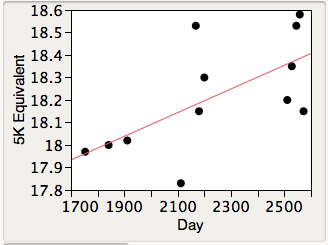
Fig. 1. I am getting slower! These are my 5K equivalent times for all races 5K to 10K distance over the last three years. For the 8K, 5M, and 10K times I used McMillan to estimate the 5K equivalent time. Day is simply number of days since a race in 2005, so you can see the 2010, 2011 and 2012 clusters. The correlation here is .65 Also notice that race times get worse through each season. You cannot tell this from the graph but my 2010 summer races were especially cool (at least B2B). This suggests...

Fig. 2 Dew Point matters! This is a pretty stunning, given all the other factors that can effect race performance including especially point in training cycle and freshness (no, mild, or full taper). The linear correlation is .81. I would expect the relationship to actually be quadratic (green line) as dew point should have little effect when low but dramatic effect when high. The quadratic component is not significant statistically but shouldn't be rejected using a model selection approach. This summer's B2B was super high dew point and I also ran a 5K in Florida. By contrast in 2010, my only 5K was in early spring and the B2B was beautifully cool and dry. This suggests...

Fig 3. GLOBAL WARMING!!!! Not really, but this is even more stunning because this very high correlation (.77) is completely coincidental. I happened to run early spring races in 2010 and 2011 and summer race days were mild in 2010, hot in 2011 and even hotter in 2012. This suggests that maybe my slowdown (Fig. 1) is only apparent and that actually what is happening is that I've been simply racing in hotter weather. This suggests...

Fig. 4. I'm not slowing! The Y axis is my 5K equivalent times corrected for dew point. That is, I used the residuals of the Times v. Dew Point regression and plotted these against Day. Voila! To verify this, I used a simple multiple regression with Dew Point (and DP^2) and Day in the model. Day explains very, very little variation above and beyond Dew Point.
Conclusion: What appears like a very clear slow down over the past 3 year is really due to the differences in the timing of my races between 2010, 2011, and 2012 AND warmer, more humid 2011 and especially 2012 compared to 2010. Sadly though, I'm not getting faster either.
file under: how to lie with statistics
Sunday, July 29, 2012
B2B training & Baldface
In May I was 100% convinced that I would not be writing this post because of writing off 2012 racing due to my RCB. Perhaps paradoxically this led to my decision to jump into the Pineland 10K for fun since any damage from the race wouldn't matter. While that race completely sucked, it did give me confidence that I could train a little harder without aggravating my RCB to an unrunnable state. I set a pretty conservative goal - a workout (interval, tempo, or long run) every 4 days or so instead of the more typical every-other day. My intervals and tempos have also been conservative - My tempos have been at something between MP and 1/2MP while my intervals have been 1/3 - 1/2 mile hill repeats at a hard effort. No track work. Only one Daniel's 20 minute tempo at 15K pace. I also entered a few road races and counted these as workouts. In the end, I'm extremely happy with my buildup for B2B considering that I thought I would still be running 10 min/mile trail runs at this point.


I'm averaging just shy of 50 mpw, which is the same mileage as 2010 when I set my 10K PR and 5 miles/week less than last year. Not really high mileage for my time goals but I cannot seem to find the mojo to train more. I do feel like I'm only a bit short of 2010 fitness but the early forecast for B2B is high humidity (dew point of 66F) so I'm expecting a slogfest like 2011 instead of a PR day like 2010.
Today I celebrated my buildup with a sweet Baldface Loop with Don, Tom Hoag, and Susannah. We had cool temps but 100% humidity, which meant wet rocks and bodies. I went at a steady-moderate pace (about 53 min) to the first false summit (at the top of the ledges below South Baldface) but took it easy after that. We descended the Bicknell trail which has very spectacular views of the cirque and loop. Then we took the Eagle Cascade link over to the Baldface Circle trail. The link trail was through really, really beautiful forest. Emerald Pool was the perrrrrrrrfect temperature. My total run was about .4 miles long because I did a down and back from the false summit to allow the others to catch up : ). After the run we stopped at the Stow Corner Store, which was recommended by Ian and Emma. I had a large slice of pizza and gIANt cinnamon roll topped with a secret recipe crumble and whipped cream.


I was hoping to get a few solid 60 mile weeks in but that didn't happen. Here is my mileage compared to the last two years.
Today I celebrated my buildup with a sweet Baldface Loop with Don, Tom Hoag, and Susannah. We had cool temps but 100% humidity, which meant wet rocks and bodies. I went at a steady-moderate pace (about 53 min) to the first false summit (at the top of the ledges below South Baldface) but took it easy after that. We descended the Bicknell trail which has very spectacular views of the cirque and loop. Then we took the Eagle Cascade link over to the Baldface Circle trail. The link trail was through really, really beautiful forest. Emerald Pool was the perrrrrrrrfect temperature. My total run was about .4 miles long because I did a down and back from the false summit to allow the others to catch up : ). After the run we stopped at the Stow Corner Store, which was recommended by Ian and Emma. I had a large slice of pizza and gIANt cinnamon roll topped with a secret recipe crumble and whipped cream.

Wednesday, July 25, 2012
racing, heat, humidity, sun energy
In preparation for the B2B next week, I've looked a little more into climate factors that affect pace. A very nice explanation of humidity and dew point is here. Dew point is the better guide to comfort level. Kristin Barry sums it up with this chart:
| DEW POINT (°F) | RUNNER'S PERCEPTION | HOW TO HANDLE |
| 50–54 | Very comfortable | PR conditions |
| 55–59 | Comfortable | Hard efforts likely not affected |
| 60–64 | Uncomfortable for some people | Expect race times to be slower than in optimal conditions |
| 65–69 | Uncomfortable for most people | Easy training runs might feel OK but difficult to race well or do hard efforts |
| 70–74 | Very humid and uncomfortable | Expect pace to suffer greatly |
| 75 or greater | Extremely oppressive | Skip it or dramatically alter goal |
I've roughly estimated the mid-point T and dew point for my summer races for the past 3 years using the climate history data at weather underground.
Year Race T Dew Point Result
2012 Bridge of Lions (Florida) 78F 73F 18:32
2012 LL Bean 10K 66 63 38:06
2012 Fathers Day 5K 61 48 18:12
2011 B2B 10K 68 64 38:00
2011 LL Bean 10K 65 65 38:30
2011 Mothers Day 5K 58 49 17:52 PR
2011 Mothers Day 5K 58 49 17:52 PR
2011 Clam Festival 5Mile 70 58 30:0x PR
2010 B2B 10K 58 48 37:24 PR
I also think the directness of the sun matters (so the sun temp and not shade temp) since most of these races are run in direct sun and not shade but I don't have any historical record of sun temp.
What amazes me is the actual temperature of the maine races is generally very cool but comparing the dew temp with the chart shows that some of the races will suffer, such as both LL Bean's and the 2011 B2B. B2B 2010 was really perfect. And again, male runners over 35 y.o. and in top 400 who competed in 2010 and 2011 were, on average, exactly 1.0 minute slower in 2011 than 2010 (N=61). In this light, I guess my Bridge of Lions 5K isn't too bad but it's really hard to compare since that is my only race in that kind of temp/dew point.
Saturday, July 21, 2012
Florida Five
My speedwork for this week was the Bridge of Lions 5K in St. Augustine Fl. My goal for the race was to go out a little slower than 18 min. pace and see if I could hang on in the heat and humidity and maybe even break 18. My first mile was 5:50, so right on target. And I was feeling shockingly good. Mile two was 5:49. Now I started to think about breaking 18 with a fast 3rd mile. I had started to feel a little pain a little after the 1/2way mark, which is pretty typical in a 5K for me. By mile 2 I was still ok. Finished mile 3 in 5:53. Hmm - definitely a slow down there and not a speed up but still looking at very low 18s. I crossed the finish line in 18:32 - so a good 20-25s slower than where I thought I was. What happened? Did I walk the last .1 mile? What happened was a major mismatch between my watch and the official distance, which is USATF certified. My final pace according to my watch was 5:50 but my pace according to a 5K distance was 5:58, an 8 sec/mile difference (the race results say 5:59 pace). My watch has never been more than 2s/mile off on a road race. Maybe I failed to run tangents although I was thinking about these. Look at the course:


That's a lot of turns. I gmap-pedometered the course using the automatic route finder and got 3.21 miles. I then did the manual gmap pedometer making sure to mark the tangents and got 3.15 miles. This all points to the importance of tangents on a turny course. Ah well. It's a race and we all ran the same course. I finished 14th T13th overall (thanks mom for noticing this) and 2nd master.
The course itself is ok. It starts at the very cool fort (the Castillo de San Marcos), crosses the Bridge of Lions, and then turns into the old Davis Shores neighborhood, which is a nice old neighborhood. The turns in the neighborhood are a bit excessive. And running a race in Florida in the summer is kinda stupid. Other than that, it was quite nice and I'll run it again if I happend to visit the padres in mid-July again.
Which reminds me, I'm in St. Augustine visiting my parents and sisters and their familias. My parents moved to St. Augustine Beach after my dad retired from UF in Gainesville. Here are my other runs from the week. No hill repeats this week!

All on the beach except my 14 mile concrete sidewalk run on Sunday.
Wednesday, July 4, 2012
LL Bean 10K
LL Bean in 38:06 this morning in cool but very humid weather. Race analysis paralysis to follow.
I'm happy with the result because 1) I'm focussing on the 25s faster than last year's race AND 2) the fact that I really haven't taken my workouts down to even 10K pace AND 3) I raced so poorly last summer/fall so I need to be happy about something
- The Good - won my AG
- The Bad - as Ryan noted, my AG is certainly less competitive TO WIN then either M40-44 or M50-54
- The Bad - My 5K conversion time was 8s slower than FD5K last month and my FD5K was 22s slower than my 2011 MD5K on the same course
- The Good - I was 25s faster than last year's LL Bean 10K.
- The Bad - I ran this race last year at the end of a 60 mile week. This year was a 50 mile week with a rest day 2 days before the race. The weather this year was maybe slightly cooler and slightly less humid (last year's humidity was about 150%)
- The Good - I have done zero running faster than 1/2MP since last October?November? other than FD5K and the 1st half of the Pineland 10K.
I'm happy with the result because 1) I'm focussing on the 25s faster than last year's race AND 2) the fact that I really haven't taken my workouts down to even 10K pace AND 3) I raced so poorly last summer/fall so I need to be happy about something
Sunday, June 17, 2012
Mount W and FD5K: Not your doctor's management plan

We stayed at the summit for about 1 hour and then took the Tuckerman Ravine trail down. I had never been in the ravine so was eager to see it despite the looooooong train of hikers ascending. This made for slow progress. Once we passed ho-jos we did a very ez jog down the ski trail. At one point I turned around to look for Susannah and noticed two guys running down at a moderate pace and figured they had also run up to watch the race. But it was Sage Canaday (1st place) and Max King (8th place) - not who I was expecting to see running down the trail (wasn't there an awards ceremony at the base of the auto road?). We also ran into Chuck and Katy heading up! Our time down was about 2 hours and our pace on the ski trail was about the same as that climbing it! My left retrocalaneal bursitis and my right achilles felt surprisingly good until we spent 5 minutes soaking our feet in the very cold river and THEN starting jogging again. Running on the frozen tendons was NOT what the doctor ordered.
I had also been planning on racing the Sea Dogs Father's Day 5K since I signed up for the MD5K back in February. I bailed on the MD5K due to injury. I still have the same injury but I've either grown in wisdom (that I can race on it) or thrown wisdom out the window. I also decided to race in my asics piranahs, which are about the sweetest, reasonably durable racing flats out there (< 5 oz). The low heel drop (4 mm) and fast pace would put a strain on my L and R achilles that they hadn't seen in 9 months. The race went well enough, I guess I thought a 18:15 was on the table but given my complete lack of fast training (other than last week my fastest training pace was about 7:20 - last week I dropped this to 6:40). I ran 18:12 so I'm pretty happy with that. I even outkicked some guy in the last 100 m. Following the race I did a 4 mile cool down, also in the Piranahs despite having brought wu/cd shoes.
Mountain runs and 5Ks in low-heal racers are not the conventional prescription for calf/achilles/RCB issues. I'm going to take this weekend as a green light that I can bump up my running and maybe even train to race and not just run slow in the woods.

Monday, June 4, 2012
Pack Monadnock

The Course
The race is point-2-point and despite the elevation profile, is quite rolling with short climbs and descents and a net gain of around 670 feet over the first 7 miles. The first mile climbed 260' in a 3/4 mile stretch. That's a good way to start a race! The 8th mile (still not on the mountain) climbs another 190 feet. The first 8 miles averages 197 feet of elevation gain per mile, which is slightly more than, say, climbing Mountain Rd in Falmouth (about 180'/mile). This is hilly for a road race but certainly not a mountain run. The Mid-Winter Classic 10 miler averages 70' per mile elevation gain, so is super flat by comparison. The first 7 miles really did roll; the number of descents surprised me enough that I wasn't actually sure that we had done any net climb by mile 7 (obviously my "feel" was way off).
At 7.9 miles the course turns onto route 101 and there is a good climb (6-8% grade) to the park entrance. At 8.7 miles you enter the park and actually start the mountain climb. The race web site advertised grades like Mt. Washington and it didn't disappoint. The first 1/2 mile of road is about 12-14% grade continuous. This is harder than Mt. Washington. The second 1/2 mile is back to about 6-8% and makes you feel like running, if you still have gas in the tank. The last 1/3 mile starts with a Mount Washington grade but then turns onto a loooooong wall of >20%. The wall is maybe 200 meters, which is much longer than the final wall on Mt. Washington and just as steep. It's sick.

Grade over the last 2.1 miles (from the turn onto Rt. 101 to the finish). The park rd. begins at mile 8.7. Individual points for the grade were averaged over 11 gps points (taken every 3 seconds) so even the red line is smoothed. The error is in the location of the GPS point which on a steep hill can create lots of noise.
My Race
I'll be brief. My goal was 1:18 which seemed conservative but given my 10K last week maybe even this was optimistic. I was very conservative on the first mile (which was again very uphill) and lots of people passed me. I passed a few people after mile 1 but then settled into a long lonely race where I ran alone, wasn't passed by anyone, and took about 6 miles to close the 50 meter gap with the two guys in front of me. Once I caught them I dropped them quickly and slowly closed the gap with another pack of about 5. I passed this entire pack on the Rt. 101 section between mile 8 and the park entrance (mile 8.7). On the park road, I passed about 4-5 more runners, and again, wasn't passed by anyone from behind. Finish time was 1:17:55 for 38th out of 201 runners. Wow, nailed the goal which is good, but not great since it was a conservative goal.
My Achilles
About 10 days ago I started to lean toward the source of pain being retrocalcaneal bursitis rather than insertional achilles. I based this conclusion on the ability to cause pain when I poked my heel with the achilles flaccid but not when tensed (hence the pain would seem to be deep to the tendon unless a tense tendon isn't painful for some reason). In response, I started myself on an NSAID treatment, which is usually something that I avoid (again tendon injuries aren't typically inflammation but tears).
Tuesday, May 29, 2012
My Garmin premium softstrap HRM sux
My average HR for the mile segment of the Pineland 25K from the River Loop, through the field to the base of the Campus loop (location of the Pony aid station) yesterday was 173. This is about my HR max. I was running easy. My average HR over the 2nd mile of my run today was 77. This is the rate of a slow walk but again I was running easy on roller coaster singletrack. Apparently my "ez run HR" ranges between 77 to 173.
Monday, May 28, 2012
Pineland Double

Racing, or Fun?
I decided to double this weekend. My flow of thought went something like this. "I have no goal races this year. I'm running the 25K easy with friends. Jamie and Ryan and Scott jumped into the 10K. I want to race them. Jumping in the 10K can't keep me from racing any goal race since I don't have one. ergo - I'm going to jump into the 10K too." So my goal was to race the 10K and hope that I didn't aggravate my achilles enough to not run the 25K. I thought this would be about a 25% chance of making it to the 25K.
At the start of the 10K I decided that I was going to go for it. My only clues to my fitness level were that I couldn't keep a 25K race pace for more than about 2 miles 4 weeks ago and I couldn't keep a 5K track pace for more than about 1200 meters 2 weeks ago. Those are pretty big red flags, but I ignored them. Instead I went out at the pace that I should have gone out...last year. Jamie and Scott kept up, indeed for much of the first 1-2 miles we leap frogged each other. I think Ryan fell back pretty early. About the 2 mile mark, with more net downhill to go, I started feeling like the pace wasn't really sustainable but still felt surprisingly fit. By 3 miles I was toast and just like toast, nothing could untoast me. Not drinking at the aid stations, which I did. Not walking, which I did. Scott was long gone and had a good race on a hot day. Jamie and I continued to leap frog each other or it was more like reverse leap frog because Jamie was bogging down due to the heat. Somewhere around mile 4, I slowed enough that Jamie passed me for good and I had zero will to get dragged. I nearly DNFed at every trail junction that led to a shorter path to the finish but I kept hearing Ian's voice of rebuke in my head. So I kept running at a pace that was only slightly less than extremely painful and over a minute per mile slower than the same sections of my race last year, in which I was doing the 25K! Here are the splits for 5 of the common miles of both races (the first two are downhill while the last 2 are uphill):
2012 10K 2011 25K
6:06 6:26
6:37 6:28
7:47 6:55
8:26 7:23
8:42 7:27
My foot felt little worse for the wear Sunday morning and I registered for the 25K. I did zero warm-up, as I wasn't racing, but this meant that I hadn't a clue how my foot would feel until I started running. I had decided about a week ago to run this at a 9 min pace with Mike Pratico and Paul Green. We were joined by Sam Kane, who skied for James and I on the FHS nordic team, and Pat Connolly, who is the dad of another skier on the team (Mike and I are also, of course, dads of FHS skiers). I was the pacer. The 9 minute pace proved too hard, especially on the downhill sections. We maintained a pace around 8:45 throughout, something closer to 830s on the downhill miles and 9s on the uphill miles. Our official pace was 8:48 but I kept my watch going while I ran around the Yurt aid station 3.5X while Paul was taking a bio-break. We lost Sam and Pat about 1/2way but they didn't finish too far behind us. We picked up a couple of extras in Oak Hill and paced them in. My foot felt mostly great the whole way - only slights twinges here and there. Weird. Almost makes me want to train for something.
Monday, May 21, 2012
at least I'm running
I was hoping this would be my first of a string of 60+ MPWs. But Thursday I started an ez road/trail run but had immediate and fairly substantial (4/10) achilles pain. Where had that come from? I turned around. Friday I planned to run but was swamped with grading and didn't run. So much for 60s. Wednesday was discouraging and really drove home the dichotomous choice I face - train to race and endure the pain or just have fun running and don't race at all.
Something to think about: I've been doing weekly 70-75 minute runs at my top aerobic pace (about 81-82% HRMax). These seem unusually hard - not like a tempo run but a rate that would be hard to sustain for, say, a marathon. Yet its 10-14 beats/sec lower than my HR during the Maine Marathon training runs. So why does it "feel" hard? My average marathon HR was closer to 17-18 beats/sec more. Could I sustain that now? It's easy to think of pace as waxing and waning but this comparative HR data baffles me, especially since its not like I've taken any time of from general aerobic work. I would have thought that 82% was easily sustainable its just that as I get fitter, the pace at 82% gets faster. So I can understand somewhat the variation in the ability to maintain pace at a specific HR (or VO2 percent) level. Regardless, I suspect this feeling is a consequence of the reaaaaaaalllllllly long time since I've done any regular tempo work or fast hill repeats and of course anything resembling 3K-5K track work hasn't been done since last summer.
Total Hours: 6:58:47
Total Distance: 45.9 mi.
Something to think about: I've been doing weekly 70-75 minute runs at my top aerobic pace (about 81-82% HRMax). These seem unusually hard - not like a tempo run but a rate that would be hard to sustain for, say, a marathon. Yet its 10-14 beats/sec lower than my HR during the Maine Marathon training runs. So why does it "feel" hard? My average marathon HR was closer to 17-18 beats/sec more. Could I sustain that now? It's easy to think of pace as waxing and waning but this comparative HR data baffles me, especially since its not like I've taken any time of from general aerobic work. I would have thought that 82% was easily sustainable its just that as I get fitter, the pace at 82% gets faster. So I can understand somewhat the variation in the ability to maintain pace at a specific HR (or VO2 percent) level. Regardless, I suspect this feeling is a consequence of the reaaaaaaalllllllly long time since I've done any regular tempo work or fast hill repeats and of course anything resembling 3K-5K track work hasn't been done since last summer.
Total Hours: 6:58:47
Total Distance: 45.9 mi.
Sunday, May 13, 2012
Way back
Just like my west trip in 1976 to the Wyoming and Colorado. After experimenting with what does and does not aggravate the achilles, I've narrowed it down to running fast and yard work (pushing a wheel barrow or lawnmower). While the little fast running I've done in the last couple of weeks has only minorly aggravated the achilles, I'm a little worried about any kind of systemic ramp up to real training so, being risk averse, I've decided to not run intervals, TNR sprints, strides, fartleks, and sadly, races. I backed out of MD5K. I am going to jog Pineland 25K. In mid-June I'll re-assess.
Time: 8:35
Distance: 57.7
M East Branch trail
T TMR TNR @ Twin Brook
W HR test on track
R Twin Brook
F Back Cove/East End Beach
S Pineland
S Community Park/Hadlock loop
M T W R F S S
Sched Min 45 90 60 90 45 120 90
Sched HR L0-1 L3-4 TT L1-2 L1 L3-4 L1
Time (H:M)0:55 0:47 1:04 1:32 1:01 1:51 1:24
AHR 131 132 136 134 144 125
HR % 74 75 77 76 82 71
Miles 5.6 5.5 7.9 10.5 7.2 13 8
Sunday, May 6, 2012
Heelectomy
One of the first pieces of advice that I read on insertional achilles is to cut a slit or a V into the heel counter of your running shoe. In fact, I've seen advice to do this prophylactically. I chose not to cut any of my new running shoes but I switched immediately to the Nike Frees (1st edition), which have a very soft, flexible heel counter, for my everyday shoe. After failure to find any pattern in what does and does not aggravate the achilles, I decided to cut a slit into my NB790s for my 10 mile run at Pineland yesterday. My feet felt great when I got home but I put on a pair of Wellies (rubber boots) to do some yard work and hadn't walked 50 yards before my achilles was screaming. I had worn these only a few days before with no pain so clearly there was a run X boot interaction. I switched into my slit running shoes to do yard work but the damage was done, my achilles was sore all evening. Today I woke up with zero achilles pain and ran 110 minutes in the same slit NB790s. Again, everything felt great. I then slit a pair of old NB 901 road shoes for yard work. OMFG, the 901s are considered a lightweight trainer but the heel counter was more earthquake proof than a tokyo skyscraper. It took quite the surgery to cut out a V (a simple slit wouldn't have done anything with the plastic stability plate in there). Regardless, it worked and my achilles feels fine. I'm a little hesitant to slit my new inov8 195s so I'll probably just run in old shoes for a while; hopefully not all season.
I've finished week two of easy running - no tempos, MP, intervals, fartleks, sprints, etc, although I did do strides at Twin Brook on Tuesday. And I did 4 x 800m hill repeats at 127, 132, 137, 142HR (all still very far inside my aerobic zone - less than 80% HRmax). I'm planning on running MD5K Sunday and I suspect my achilles will not be happy about that. And I suspect the 25K at Pineland will be even worse.
Total Time: 8:27
Total Miles: 55.9
M Passive Recovery
T easy 1:10 (8 mi)TMR TNR @TB
W easy 1:32 (9.3 mi), Presumpscot River Westbrook
R Fast-easy 1:15 (9.7 mi), Back Cove/East End trail
F 4 x 800 slow to fast easy hill repeats 1:08 (7.7 mi), Brook Rd/Halls Hill
S easy 1:33 (10.5), Pineland
S easy 1:48 (10.8), Presumpscot River Westbrook
M T W R F S S
Plan (min) 45 75 90 75 60 120 90
Plan (HR) L1 L3-4 L1-2 L4 L1-2 L3-4 L1-2
Time (min) 70 92 75 68 94 108
Miles 8 9.3 9.7 7.7 10.5 10.8
AHR 133 127 139 128 133 126
HR % 76 72 79 73 76 72
I've finished week two of easy running - no tempos, MP, intervals, fartleks, sprints, etc, although I did do strides at Twin Brook on Tuesday. And I did 4 x 800m hill repeats at 127, 132, 137, 142HR (all still very far inside my aerobic zone - less than 80% HRmax). I'm planning on running MD5K Sunday and I suspect my achilles will not be happy about that. And I suspect the 25K at Pineland will be even worse.
Total Time: 8:27
Total Miles: 55.9
M Passive Recovery
T easy 1:10 (8 mi)TMR TNR @TB
W easy 1:32 (9.3 mi), Presumpscot River Westbrook
R Fast-easy 1:15 (9.7 mi), Back Cove/East End trail
F 4 x 800 slow to fast easy hill repeats 1:08 (7.7 mi), Brook Rd/Halls Hill
S easy 1:33 (10.5), Pineland
S easy 1:48 (10.8), Presumpscot River Westbrook
M T W R F S S
Plan (min) 45 75 90 75 60 120 90
Plan (HR) L1 L3-4 L1-2 L4 L1-2 L3-4 L1-2
Time (min) 70 92 75 68 94 108
Miles 8 9.3 9.7 7.7 10.5 10.8
AHR 133 127 139 128 133 126
HR % 76 72 79 73 76 72
Subscribe to:
Posts (Atom)